Where to Keep Your Emergency Fund (and Where Not To)

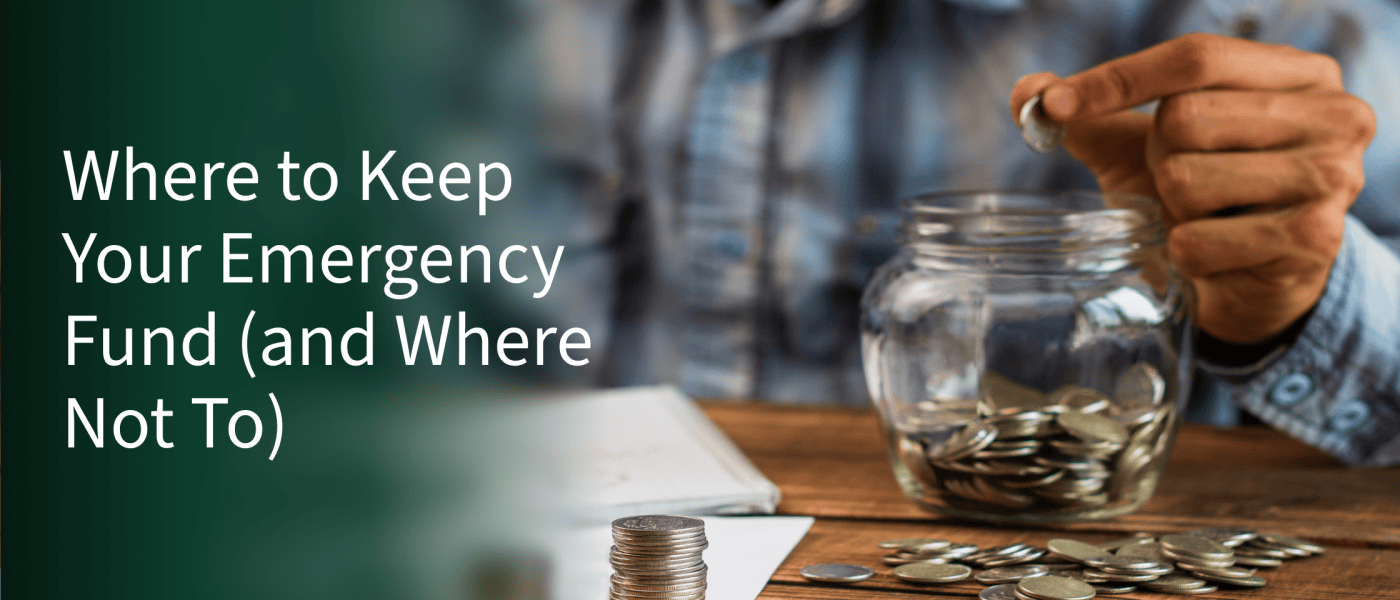
An emergency fund has one job: be there when something goes wrong. Most people keep theirs somewhere that earns almost nothing—or somewhere the money could lose value at the worst possible moment.
Two requirements: accessible quickly, and safe from loss. The FDIC insures deposits up to $250,000 per depositor per institution. That’s the floor. Beyond safety, yield matters—inflation erodes money sitting in a low-rate account year after year.
The Wrong Place First: Regular Checking and Savings
The average traditional savings account pays 0.46% APY—$46 per year on $10,000. An online high-yield account pays $450 to $500. Most people leave this money in a checking account, where it earns almost nothing and blends into daily spending. A car repair is an emergency. A concert ticket sale is not—but both are easy to fund when the money is sitting right there.
A separate bank adds enough friction. A different login and a one-to-two day transfer window prevents casual dipping without making the money hard to reach when something real happens.
High-Yield Savings Accounts: The Default Answer
Online banks have lower overhead and pass the difference to depositors. High-yield savings accounts currently pay 4.5 to 5.0% APY—FDIC insured, no withdrawal limits, accessible within one to two business days. Ally, Marcus, Discover, and SoFi are commonly cited options. Bankrate and NerdWallet track current rates—the best rate shifts monthly, but the gap between online and traditional banks has stayed wide.
One thing to check: some accounts advertise high rates that only apply to a limited balance or drop after 90 days. Read the terms before opening.
Money Market Accounts
These are essentially high-yield savings accounts with a slightly different structure. Current rates run 4.0 to 5.0% APY at competitive institutions. They’re FDIC insured and offer the same accessibility as a savings account. Some require higher minimum balances—$1,000 to $10,000—to earn the top rate or avoid fees.
If the fund is large enough to meet the minimum balance, a money market account is a reasonable option. For funds still being built, a high-yield savings account with no minimum is easier.
Worth knowing: bank money market accounts and brokerage money market funds have similar names but very different protection. Bank accounts are FDIC insured. Brokerage funds aren’t — they hold short-term securities and work differently.
Treasury Bills: A Yield Alternative
Treasury bills are short-term US government debt issued in terms from four to fifty-two weeks. Three-month T-bills were yielding 5.0 to 5.3% at mid-2024—backed by the US government, which is a stronger guarantee than FDIC insurance.
The limitation is liquidity. TreasuryDirect.gov is free but takes a few days to set up, and you’re tied to the maturity date. Better suited for the deeper reserve than money needed on short notice. Some investors ladder four-week bills so one matures each month—predictable access on a rolling basis. Brokerage accounts also allow T-bill purchase and often offer same-day secondary market sales at a small spread.
What Not to Use
Brokerage Money Market Funds
They are highly liquid—but they aren’t FDIC insured. They hold short-term securities that could fall below $1 per share, as happened in 2008. Fine for money already sitting at a brokerage. Not the right home for the primary emergency fund.
Index Funds and Stock Accounts
Emergency money in the stock market is not emergency money. A job loss and a market downturn have a documented tendency to occur at the same time—recessions produce both simultaneously. Selling into a down market to cover a car repair or a medical bill locks in losses at exactly the moment the fund is supposed to help.
The S&P 500 dropped 34% in March 2020. An emergency fund invested in the index at the start of 2020 would have been worth 34% less at the worst moment of the pandemic’s economic impact. Emergencies don’t wait for the market to recover.
I-Bonds
They can’t be redeemed for the first 12 months, and early redemption within five years forfeits three months of interest. Good for long-term savings—not for money that might be needed soon.
Account Comparison
| Account Type | Current Yield | FDIC Protected? | Best For |
| Regular checking/savings | 0.01–0.5% | Yes | Nowhere—too low yield |
| High-yield savings (online bank) | 4.5–5.0% APY | Yes (up to $250K) | Primary emergency fund location |
| Money market account | 4.0–5.0% APY | Yes (up to $250K) | Same as HYSA; check minimums |
| Treasury bills (3-month) | ~5.0–5.3% yield | US government guarantee | Portion of fund if comfortable with process |
| Brokerage money market fund | 4.5–5.2% APY | Not FDIC—SIPC only | Caution—not true emergency fund safety |
| Stock market / index fund | Varies / unpredictable | No | Never — too volatile for emergency access |
| Savings bonds (I-bonds) | Variable rate | Yes | Long-term savings only—1-year lockup |
Yield data from FDIC national rate averages and US Treasury rate data. Rates change frequently—verify current figures before opening an account.
The Two-Layer Approach
For funds above two or three months of expenses, split them. First layer—one month of essentials—in a high-yield savings account. Second layer—the rest—in a T-bill ladder or a second high-yield account. Transfer time from the second layer is one to two days for savings, a few days for T-bills. That works for most real emergencies.
How Much to Keep and Where
3 to 6 months of essential expenses is the usual target. Thirty-seven percent of adults couldn’t cover a $400 unexpected expense without borrowing — Federal Reserve data. If the full target feels distant, start with $1,000 in a high-yield savings account. That single buffer breaks the cycle where every small surprise becomes debt.
Households with variable income, commission-based work, or a single earner should lean toward the higher end of that range. The emergency fund for a dual-income household with stable employment serves a different function than one for a freelancer with irregular monthly income.
Bottom Line
Anything under 4% APY on an emergency fund at current rates is leaving money on the table unnecessarily. Don’t keep it in the stock market, in I-bonds, or in an account where it will blend into regular spending. The T-bill option makes sense for the deeper reserve layer if the setup process is manageable. But the primary fund—the first one to two months of expenses—belongs in an online savings account that’s safe, accessible, and earning a competitive rate.
Disclaimer
This article is for informational purposes only and does not constitute financial advice. Interest rates change frequently. FDIC insurance limits and terms are subject to change. Consult a licensed financial advisor before making savings decisions.

Sarah Mitchell
Sarah Mitchell, CFA Sarah spent eight years as an investment analyst before turning her attention to helping everyday Americans build wealth. She holds a CFA charter and writes about portfolio construction, retirement planning, and the math behind long-term financial independence. Her approach is rooted in data, not hype — she believes the best financial advice is boring, repeatable, and backed by numbers. When she's not writing, she's stress-testing her own retirement spreadsheet for fun.