
How to Price Your Services as a Freelancer


Most freelancers set their rate the same way: they pick a number that feels reasonable and hope clients accept it. Upwork’s Freelance Forward report found the median hourly rate across all freelance categories was $28 per hour—but that average obscures a wide range. Writers charge $15 to $150. Designers charge $25 to $200. Developers charge $50 to $300. The spread isn’t random. It reflects three different approaches to pricing, and which one is used determines how much freelancers actually take home.
This guide covers the three pricing methods, what each produces in practice, and the specific calculation that converts an income goal into a floor rate—the number below which accepting work costs money rather than making it.
The Problem With Guessing
Underpricing is the most common freelance mistake, and it compounds. A rate set too low attracts clients who expect low rates. Raising the rate later means finding new clients. The time spent at below-market rates is time not spent building toward a sustainable rate—and it often produces more work than higher-rate engagements because low-rate clients tend to need more from each dollar.
Overpricing without the skills to back it up ends engagements quickly. But overpricing is far less common than underpricing. A Freelancers Union survey found that 75% of freelancers reported difficulty with rates—nearly all in the direction of charging too little, not too much.
The floor rate calculation solves both problems. It establishes the minimum that has to come in for the work to make financial sense. Everything above the floor is a negotiating room.
The Floor Rate: Start Here
The floor rate is the hourly amount that covers costs, taxes, and the income target—nothing more. It’s not the market rate. It’s not what clients will pay. It’s the number below which the math doesn’t work.
Four inputs go into the calculation:
- Annual income target. The take-home pay needed, not the gross revenue. If the goal is to take home $75,000, start there.
- Business expenses. Software, equipment, health insurance, accounting fees, professional development. Total these for the year.
- Tax reserve. Self-employment tax is 15.3% of net income on top of income tax. A 25 to 30% reserve on gross revenue is a reasonable starting point for most income levels.
- Billable hours per year. Not total working hours. Only the hours that produce revenue. The rest disappears into admin, proposals, client emails, invoicing, and keeping skills current.
How Much of Your Time Is Actually Billable
A full-time freelancer working 40 hours per week has roughly 2,000 working hours per year. Of those, research from HubSpot and similar agency studies consistently finds that 50 to 60% of working hours are non-billable. Admin, proposals, invoicing, marketing, client communication, professional development—these don’t appear on a client invoice but consume real time.
Using 50% as the billable proportion: 2,000 hours × 50% = 1,000 billable hours per year. Subtract two weeks vacation and a week of sick time (roughly 60 hours): 940 billable hours is the working estimate. That number is the denominator in the floor rate calculation.
New freelancers often overestimate billable hours, especially in the first year. Client acquisition takes time. Proposals don’t always convert. The first year’s effective billing rate is often lower than planned—which is an argument for setting the floor rate higher, not lower, at the start.
The Floor Rate Calculation
Add the income target, business expenses, and tax reserve together. Divide by billable hours. That number is the floor rate.
Example: $75,000 income target + $8,000 business expenses = $83,000 in gross revenue needed before tax reserve. Add a 30% tax reserve: $83,000 ÷ 0.70 = $118,571 in total gross revenue required. Divide by 940 billable hours: $126 per hour floor rate—before accounting for IRS SE tax. This is the minimum hourly rate that makes the $75,000 income target achievable.
The number is usually higher than what most freelancers initially charge. That’s the point of doing the calculation—to reveal the gap between the intuitive rate and the rate that actually supports the income goal.
Rate Reference by Income Target
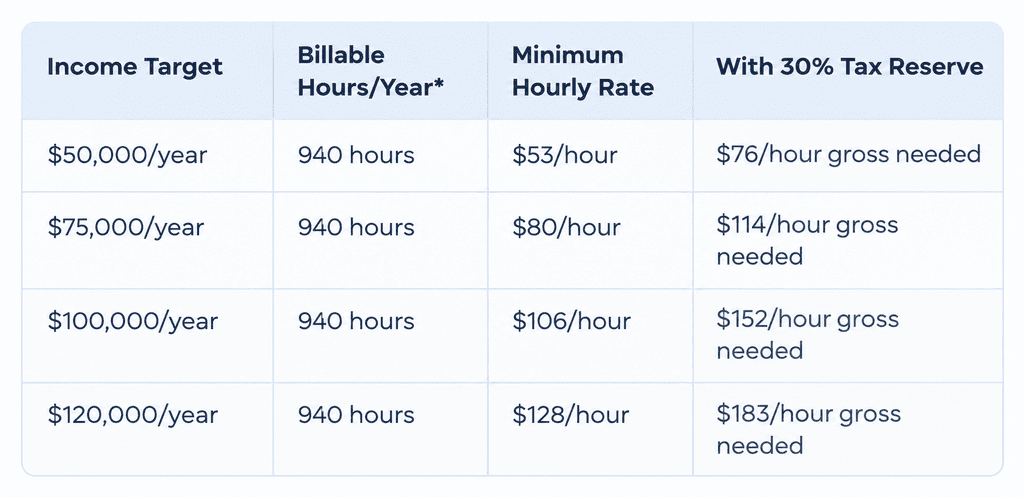
*940 billable hours based on 2,000 annual hours × 50% billable rate, minus 60 hours for vacation and sick time. Tax reserve of 30% applied to gross revenue. Business expenses not included in the table—add these to the income target before calculating.
The Three Pricing Methods
Cost-Plus Pricing
Cost-plus starts from the floor rate and adds a margin. If the floor rate is $126 and the target margin is 20%, the quoted rate is $151 per hour. This approach ensures every project covers costs, but it ignores what the market will pay—which may be higher or lower than the cost-plus result.
Cost-plus works well for straightforward, commoditized services where clients compare quotes across providers. It doesn’t work well for specialized or high-value services where market rates exceed what cost-plus would suggest—leaving significant money uncaptured.
Market Rate Pricing
Market rate pricing sets the rate at what comparable freelancers charge for similar work. Upwork’s rate data by category, LinkedIn Salary Insights, and Glassdoor all provide market benchmarks. Glassdoor shows freelance writing averaging $45 to $85 per hour; UX design averaging $65 to $130; software development averaging $75 to $175 depending on specialization and experience level.
Market rate pricing is the most defensible approach when discussing rates with clients—it anchors the number in external data rather than personal circumstances. The limitation: market rate reflects what the average practitioner charges, not what the best practitioners charge. Positioning above market rate requires clear differentiation—specialization, track record, or a niche where the supply of qualified freelancers is limited.
Value-Based Pricing
Value-based pricing starts with the client’s outcome, not the freelancer’s costs or the market average. A copywriter whose homepage redesign generates $200,000 in additional revenue for a client created $200,000 in value. Charging $3,000 for that project is cost-plus pricing. Charging $15,000 is still a bargain from the client’s perspective.
Value-based pricing is the highest-ceiling approach but requires understanding the client’s business well enough to estimate the impact of the work. Research from the Bureau of Labor Statistics Occupational Outlook Handbook shows that the highest-earning freelancers in every category—writers, designers, developers, consultants—tend to work on high-stakes projects where the outcome is measurable and the fee is tied to the value delivered, not the hours spent.
Raising Rates
The right time to raise a rate is before the next client, not mid-project. Existing clients who were quoted a rate should be notified of increases with at least 30 to 60 days notice before the new rate takes effect. Most long-term clients expect occasional rate increases. What they don’t expect is a mid-engagement price change.
A rate increase of 10 to 20% annually is reasonable for a freelancer gaining experience and delivering consistent results. The Bureau of Labor Statistics Employment Cost Index tracks wage growth across industries—freelancers whose rates don’t keep pace with market wage growth effectively take a pay cut each year in real terms.
The most effective signal that a rate needs to increase: every new client accepts it without hesitation. Some pushback on rate is healthy—it means the rate is at the upper edge of what the market will bear for that level of service. No pushback at all usually means the rate is below market.
Bottom Line
Set the floor rate first. It tells you the minimum that has to come in for the work to make sense. Then compare that floor to market rates for the type of work and experience level. If the floor is below market, there’s room to price above the floor. If the floor is above market, the gap has to close somewhere—either through higher-value positioning, lower expenses, or a different service mix. The number that produces both a sustainable income and a competitive position in the market is the rate to quote.
Disclaimer
This article is for informational purposes only and does not constitute financial, tax, or business advice. Tax obligations for self-employed individuals vary. Consult a licensed tax professional for guidance specific to your situation.

Sarah Mitchell
Sarah Mitchell, CFA Sarah spent eight years as an investment analyst before turning her attention to helping everyday Americans build wealth. She holds a CFA charter and writes about portfolio construction, retirement planning, and the math behind long-term financial independence. Her approach is rooted in data, not hype — she believes the best financial advice is boring, repeatable, and backed by numbers. When she's not writing, she's stress-testing her own retirement spreadsheet for fun.