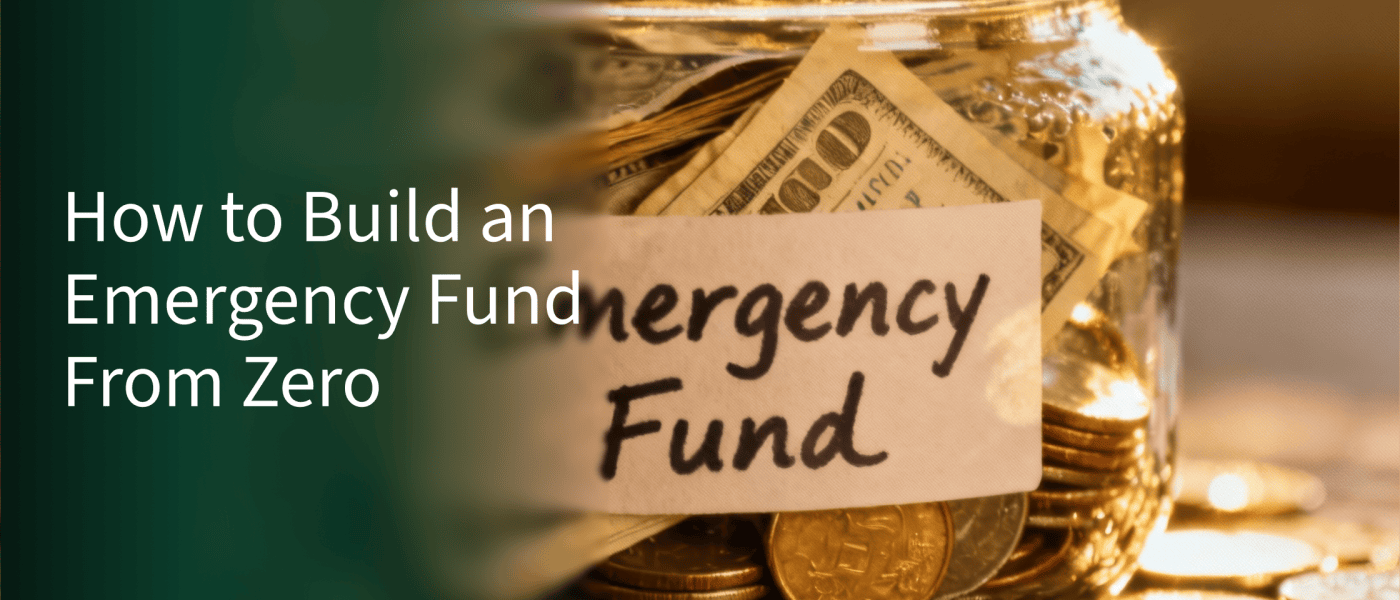
How to Build an Emergency Fund From Zero

The standard advice is to have three to six months of expenses saved before anything else. That’s the right destination. But it’s a terrible starting point when the account balance is zero. The Federal Reserve found that 37% of adults couldn’t cover a $400 unexpected expense without borrowing. For those households, “save three months of expenses” isn’t actionable advice. It’s a distant goal that discourages action on the immediate problem.
This guide works backward from where most people actually start—nothing—and covers the specific steps, in order, that build the fund from zero to functional.
Why $1,000 Is the Real First Goal
Three months of expenses sounds achievable until the math lands. Three months of essential expenses — rent, utilities, food, insurance, minimum debt payments—runs $4,000 to $9,000 for most households. That number is demotivating when the starting balance is $47. Research from the Urban Institute found that having as little as $250 to $749 in liquid savings significantly reduced the likelihood of financial hardship compared to having nothing. The full three-month target isn’t required for the fund to start doing its job.
The $1,000 milestone handles most single-event emergencies: a car repair, a medical copay, a broken appliance, a dental bill. It doesn’t handle a job loss—that’s what the full three to six months is for. But it stops the most common financial spiral, which starts with a $500 unexpected expense landing on a credit card that then takes months to pay off at 21% interest.
Start with $1,000. The three-month goal comes after.
Where the First $50 Comes From
Saving when there’s nothing left at month-end requires finding money that’s already there but leaking. Most households have it—it’s just not in an obvious place.
The Subscription Audit
Pull up the last two months of bank and credit card statements. Mark every recurring charge. C+R Research found the average household spends $219 per month on subscriptions while estimating they spend only $86. The gap between estimate and reality is typically $30 to $80 per month in services that are forgotten or barely used. Cancel anything unused in the last 30 days.
Phone Bill
Major carrier plans run $60 to $90 per line. MVNOs—Mint Mobile, Visible, Consumer Cellular—run $15 to $35 on the same networks. Consumer Reports finds no meaningful service quality difference for most users. Switching saves $25 to $55 per month per line.
Bank Fees
Monthly maintenance fees at traditional banks average $15.33 per month—Bankrate 2024. Online banks—Ally, SoFi, Discover—charge nothing. Switching takes about two weeks. The fee stops the following month.
One Recurring Expense Cut
Pick the one spending category that varies most month to month—dining out, coffee, online shopping—and set a specific lower limit for 60 days. Not permanent. Not a lifestyle overhaul. Sixty days of reduced spending in one category to fund the initial deposit.
The Setup That Makes It Automatic
Finding the first $50 manually works once. Doing it month after month doesn’t. The fund has to run without requiring a decision every pay period.
Open a savings account at a different bank than the primary checking account. This is important. A savings account at the same bank is too accessible—it gets spent on non-emergencies. A different bank, different login, and a one-to-two-day transfer window creates enough friction. High-yield savings accounts at online banks currently pay 4.5 to 5.0% APY. The fund earns something while it builds.
Set up an automatic transfer from checking to that savings account on the day after each paycheck hits. The amount doesn’t need to be large—$25 or $50 per paycheck is a real start. The key is that it happens automatically, before the money has a chance to be spent on anything else.
This is the principle behind behavioral economics research on automatic savings. Thaler and Sunstein’s work on default settings—Nobel Prize economics—showed that automatic enrollment produces significantly better savings outcomes than systems requiring active decisions. The automatic transfer is that principle applied directly.
How Long It Takes
At $50 per month, reaching $1,000 takes 20 months. At $100 per month, 10 months. At $200 per month, 5 months. These feel slow. They aren’t—they’re faster than most people would reach $1,000 without a system, which is approximately never.
The timeline compresses when windfalls are redirected. A tax refund, a work bonus, a side job payment, the proceeds from selling something—directing any of these to the emergency fund skips months of automatic transfers. The automatic transfer handles the base. Windfalls accelerate it.
The average federal tax refund in 2024 was $3,011—IRS data. Depositing even half of that into the emergency savings account covers the $1,000 milestone in a single transaction. The other half can go to the next financial priority.
When an Emergency Hits Before the Fund Is Ready
The fund will almost certainly get used before it’s complete. That’s fine. That’s what it’s there for. A $300 car repair that hits while the balance is $600 leaves $300 in the account—which is still $300 more than a credit card bill at 21%.
After the emergency, the automatic transfer keeps running. The fund rebuilds from wherever it landed. The system doesn’t require starting over—it requires patience. The key behavioral decision is to not cancel the automatic transfer after a drawdown. That’s the moment most people abandon the fund, and it’s the moment that matters most.
Emergency funds that get used and replenished produce better long-term outcomes than funds that sit untouched. Research from the CFPB on household financial resilience found that the ability to absorb a financial shock and recover—rather than never having the shock—was the defining feature of financially resilient households.
The Full Target: Three to Six Months
Once the $1,000 milestone is reached, the target expands. Three months of essential expenses—not total spending—is the standard goal. Fidelity defines essential expenses as housing, utilities, groceries, minimum debt payments, and insurance. For most households, that runs $3,000 to $7,000.
Households with variable income—commission-based work, freelance, seasonal employment—should aim for the higher end of that range. A dual-income household with stable employment can maintain the lower end. The difference isn’t arbitrary; it reflects how long it typically takes to replace lost income in each situation.
The account that holds the full fund is the same high-yield savings account at the different bank. The only thing that changes is the target balance. The automatic transfer keeps running until the target is hit, then the transfer can be redirected to the next financial priority—investing, debt payoff, or whatever comes next in the household’s specific sequence.
What the Account Earns
A $5,000 emergency fund at a traditional bank earning 0.46% APY earns $23 per year. The same balance at an online high-yield savings account earning 4.75% APY—FDIC data—earns $237 per year. The difference isn’t the fund’s primary purpose, but $214 of additional earnings per year with no additional effort is a reasonable secondary benefit of putting the money in the right place.
Bottom Line
The emergency fund doesn’t start at three months. It starts at the next automatic transfer. Find the leaks in the current spending—subscriptions, fees, one category of variable spending—and redirect that amount to a separate account at a different bank. Set the transfer to run automatically after every paycheck. Windfalls accelerate it. Emergencies pause it temporarily. The transfer keeps running regardless. The $1,000 milestone changes how financial stress operates. The three-month target changes how financial risk operates. Both are worth having.
Disclaimer
This article is for informational purposes only and does not constitute financial advice. Individual circumstances vary. Consult a licensed financial advisor for guidance specific to your situation.

Sarah Mitchell
Sarah Mitchell, CFA Sarah spent eight years as an investment analyst before turning her attention to helping everyday Americans build wealth. She holds a CFA charter and writes about portfolio construction, retirement planning, and the math behind long-term financial independence. Her approach is rooted in data, not hype — she believes the best financial advice is boring, repeatable, and backed by numbers. When she's not writing, she's stress-testing her own retirement spreadsheet for fun.