How Self-Employment Taxes Work


Going freelance or starting a side business comes with a tax surprise most people don’t see coming. When you work for an employer, Social Security and Medicare taxes get pulled from your paycheck automatically—you never think about them. When you work for yourself, nothing gets withheld. Then April arrives.
The self-employment tax rate is 15.3% of your net self-employment income—IRS data. That’s before a dollar of regular income tax. On $50,000 in freelance income, you’re looking at $7,650 in SE tax alone. It’s a lot. But it’s also predictable once you understand how it works—and there are real ways to reduce it.
Where the 15.3% Comes From
As an employee, this tax gets split. You pay 7.65%; your employer pays another 7.65% without you ever seeing it. When you work for yourself, you’re both sides of that equation—so the full 15.3% lands on you.
The split: 12.4% goes to Social Security, 2.9% to Medicare. Both hit your net profit—revenue minus business expenses. That’s why tracking expenses matters beyond just income tax. It reduces the SE tax too.
The 2024 Social Security cutoff is $168,600. Above that, the 12.4% stops. Medicare’s 2.9% keeps running with no ceiling. Single filers above $200,000 get an extra 0.9% Medicare surcharge on top.
The Deduction That Cuts the Bill
Here’s the part most new freelancers miss: you can deduct half the SE tax you pay when calculating your regular taxable income. This goes on Schedule 1 of your 1040—IRS. It doesn’t reduce the SE tax itself, but it lowers the income your income tax is based on.
On $50,000 of net self-employment income, the SE tax comes out to about $7,065 (the IRS uses a slight adjustment before calculating the full amount). Half of that—$3,532—is deductible. That brings your taxable income down to $46,468. At a 22% federal rate, you save roughly $777 in income tax. It adds up.
You don’t have to do anything special to claim this. It flows automatically when you file Schedule SE with your return.
Paying as You Go: The Quarterly System
Here’s where people get tripped up. The IRS expects you to pay taxes as you earn money—not all at once in April. If you wait until April to pay everything, you’ll likely owe an underpayment penalty on top of the tax bill itself.
Two ways to stay out of penalty territory: pay in four equal installments what you owed last year in total, or pay 90% of what you expect to owe this year—IRS Publication 505. Either one works. For your first year freelancing, the simpler path is to estimate each quarter from what you actually earned and pay that. No guessing required.
The math isn’t complicated. Take the quarter’s net income, multiply by 92.35% (an IRS adjustment), apply 15.3% for SE tax, then add what you’d owe in income tax at your bracket. Pay that total four times a year.
When Payments Are Due

Dates from IRS Publication 505. Weekend or holiday due dates shift to the next business day.
Write-Offs That Actually Help
Tracking expenses cuts both tax bills simultaneously—income tax and SE tax drop together. Most first-year freelancers underestimate how much difference this makes until they see the numbers.
Working From Home
If you use a special space at home only for work, it qualifies. The simple method: $5 per square foot, up to 300 square feet—IRS. That’s up to $1,500 off your taxable income. No receipts needed—just the square footage.
Miles Driven for Work
Keep a log of business trips—client visits, supply runs, anything work-related. The IRS rate in 2024 is 67 cents per mile. Apps like MileIQ track this automatically. 500 miles per month is $402 off your taxable income.
Health Coverage
If you cover your own health insurance and aren’t eligible through a spouse’s plan, the full premium is deductible—off your adjusted gross income directly, not as an itemized deduction. On $8,000 a year, that’s a real dent in both tax bills.
Retirement Contributions
A SEP-IRA lets you contribute up to 25% of net self-employment income—up to $69,000 in 2024—IRS. Those contributions are completely deductible. A Solo 401(k) works similarly with slightly different mechanics.
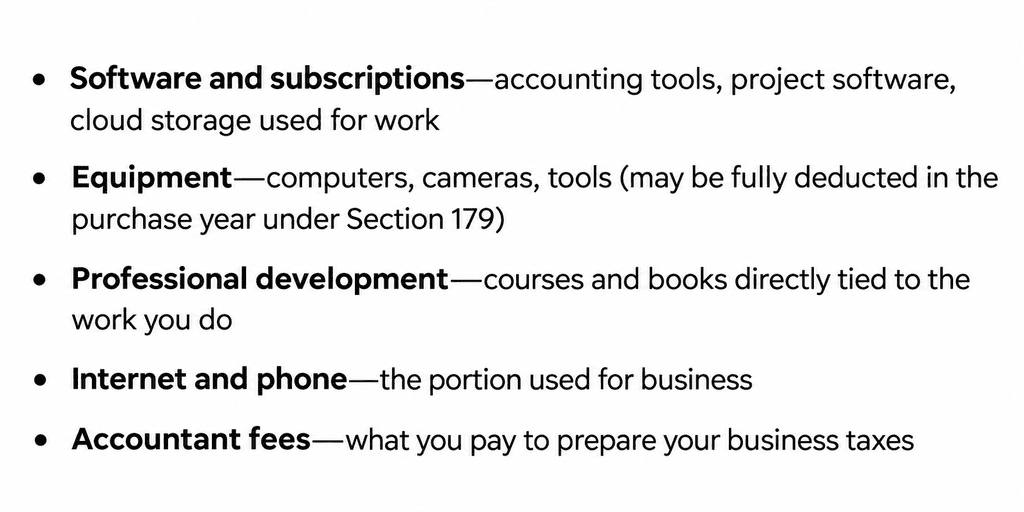
Other Things You Can Write Off
The Setup That Makes This Manageable
Open a separate checking account for business income and expenses. Every client payment goes in; every business expense comes out. At the end of each quarter, the net balance tells you what to base your estimated payment on. Without a separate account, you’ll spend hours at tax time sorting personal and business transactions.
As money comes in, move 25 to 30% into a separate savings account. A $4,000 client payment means $1,000 to $1,200 goes into the tax reserve right away. High-yield savings accounts currently pay around 4.5 to 5.0% APY—FDIC data—so the reserve earns something while it sits. When the quarterly deadline comes, you already have the money set aside.
Accounting software tracks income and expenses throughout the year and generates quarterly estimates automatically. The time investment upfront saves hours at tax time and prevents the kind of guessing that leads to underpayment penalties.
Bottom Line
The rate is 15.3% of net income—that’s before income tax. You cover both the employee and employer share. Half of what you pay is deductible, which shaves a bit off the income tax side. Skip quarterly payments and you’ll owe a penalty even if you pay everything in April. Every business expense you track cuts both bills at the same time. The setup: one separate account, a 25 to 30% reserve on every payment, four quarterly payments per year.
Disclaimer
This article is for informational purposes only and does not constitute tax or financial advice. Tax rules change annually. Consult a licensed tax professional for guidance specific to your situation.

Sarah Mitchell
Sarah Mitchell, CFA Sarah spent eight years as an investment analyst before turning her attention to helping everyday Americans build wealth. She holds a CFA charter and writes about portfolio construction, retirement planning, and the math behind long-term financial independence. Her approach is rooted in data, not hype — she believes the best financial advice is boring, repeatable, and backed by numbers. When she's not writing, she's stress-testing her own retirement spreadsheet for fun.