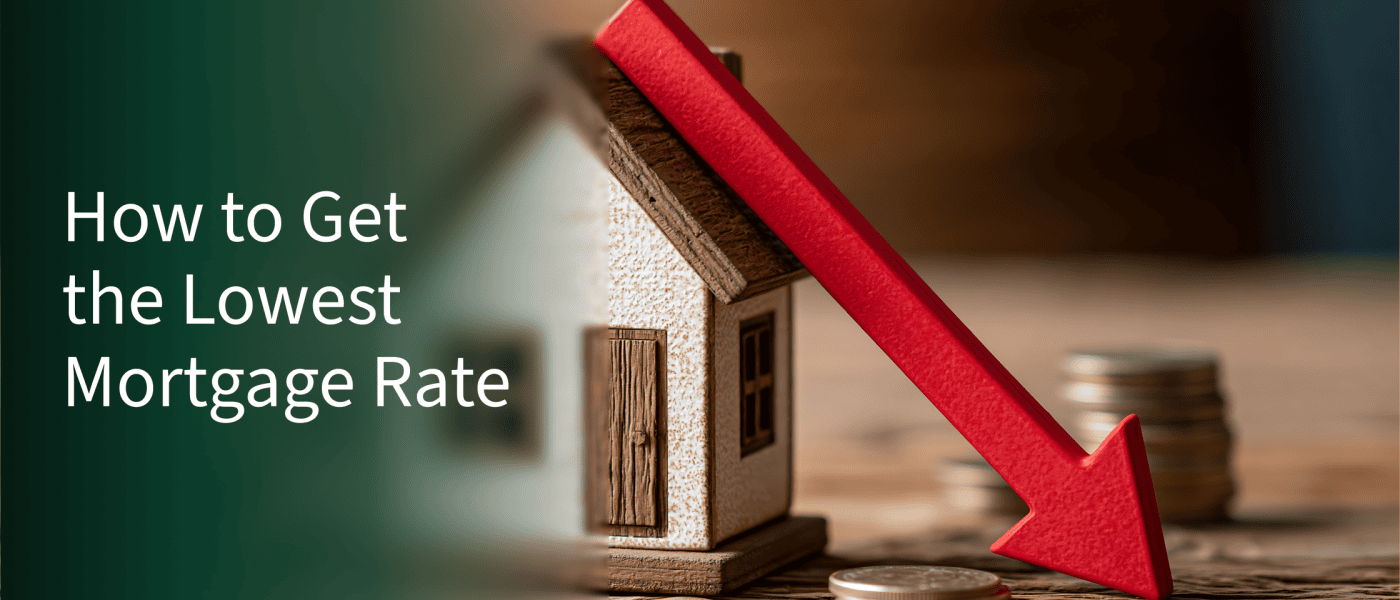
How to Get the Lowest Mortgage Rate

The rate you’re quoted on a mortgage isn’t random. Lenders run a calculation. Your credit score, your down payment, how many lenders you contact, which loan type you choose—each one feeds into the number they put in front of you. Change any of those inputs and the number changes.
On a $400,000 loan over 30 years, the gap between 6.5% and 7.0% is about $130 a month—CFPB mortgage calculator. Over 30 years that’s roughly $47,000. The buyers who end up with the lower rate didn’t get lucky. They did different things in the months before applying.
The Score Bands That Actually Matter
Credit scores don’t move rates evenly—they move them in jumps. The thresholds where pricing actually changes sit around 620, 640, 680, 720, and 760. Getting from 679 to 680 is meaningless. Getting from 719 to 720 can knock 0.25% off the rate. FICO’s loan savings calculator puts a 760-score borrower at roughly 6.5% on a $400,000 30-year loan. A 680-score borrower on the same loan gets quoted around 7.1%. That 0.6% difference adds up to about $85,000 over the life of the loan.
The practical move before applying: pull all three credit reports and go through every line. Not to check the score—to find errors. A payment marked late that wasn’t, a balance reported higher than it actually is, an account that doesn’t belong to you. Any of these can hold the score below a better pricing tier.
AnnualCreditReport.com gives free access to reports from all three bureaus. Disputes take about 30 days to resolve. Starting this process two to three months before applying gives time to fix errors before the lender runs the credit pull that sets the rate.
Card balances matter separately from errors. The score reflects how much of each card’s limit is currently being used. Using 80% of a card’s limit pulls the score down hard. Get each balance below 30% before applying—below 10% if possible. That alone can add 20 to 40 points and tip the score into a cheaper pricing tier.
Down Payment: Two Benefits, Not One
A down payment of 20% or more eliminates private mortgage insurance—an extra monthly cost that adds 0.5% to 1.5% of the loan amount per year. On a $350,000 loan, that PMI bill runs $145 to $175 a month—Urban Institute housing finance data. It disappears the moment the down payment clears 20%. That’s before accounting for any rate improvement.
The rate itself typically improves at specific down payment thresholds: 5%, 10%, 15%, and 20%. Crossing from 9% to 10% down can produce a small improvement. Crossing from 19% to 20% almost always produces a meaningful one—on the rate and by eliminating PMI simultaneously.
If 20% down means waiting another year to buy, the math gets more complicated. The rate and PMI savings have to be weighed against what home prices do during the wait. That calculation comes out differently in different markets. It’s worth running both scenarios before deciding how long to wait.
Shopping Around Is the Biggest Lever
Most buyers contact one or two lenders. Freddie Mac research found that borrowers who collected five quotes saved an average of $3,000 over the life of the loan compared to buyers who got only one. That gap exists because lenders price the same borrower profile differently based on their own funding costs and how aggressively they’re competing for loans at any given time.
Three lender types that consistently price differently from each other: traditional banks, credit unions, and mortgage brokers. Banks use their own money and set their own rates. Credit unions are owned by members and frequently price below banks on identical applications. Brokers access wholesale lenders directly—the same channels banks use to fund their own loans—and can sometimes find rates that retail lenders don’t offer.
Multiple mortgage applications don’t damage the score the way multiple credit card applications do. FICO counts all mortgage inquiries within a 45-day window as one. Contact five lenders in the same month—same hit as contacting one.
Loan Type: Not Everyone Starts From the Same Baseline
VA loans are available to eligible veterans and active-duty military and consistently price below conventional loans. VA loan program data shows VA rates averaging 0.25% to 0.5% below conventional loans for the same borrower profile—with no required down payment and no PMI. For anyone who qualifies, comparing a VA loan against a conventional loan isn’t optional. It’s the first comparison to run.
USDA loans cover eligible rural and suburban properties—low rates, no down payment required. FHA loans accept scores as low as 580 with 3.5% down, but mortgage insurance is mandatory and sticks for the life of the loan in most cases. For borrowers who qualify for both FHA and conventional, that insurance cost usually makes FHA the pricier option over time.
The loan term changes the rate too. 15-year fixed mortgages typically run 0.5% to 0.75% lower than 30-year fixed—Freddie Mac’s weekly PMMS survey. The monthly payment is higher. But total interest paid over the loan life drops dramatically. For a buyer who can manage the higher payment, the 15-year often saves more money than any other single decision in the mortgage process.
Points: Paying Now to Save Later
Discount points let you pay cash at closing to lower the rate. One point costs 1% of the loan amount and typically reduces the rate by 0.25%. On a $400,000 loan, one point is $4,000 paid upfront to drop the rate from 7.0% to 6.75%—saving roughly $65 a month. The CFPB explains how points work and how to calculate whether they make financial sense for a specific situation.
The break-even on that $4,000 point is about 62 months—roughly five years. If the home sells or the loan refinances before the five-year mark, the point was a losing trade. If the loan runs past five years, it starts saving money. Points make the most sense for buyers who plan to stay in the home for at least seven to ten years and who have the cash to pay them without pulling from the down payment.
When to Lock
Mortgage rates move daily based on bond market activity. A rate quoted on a Monday can be different by Wednesday. A lock guarantees the quoted rate for 30, 45, or 60 days while the loan processes. Mortgage News Daily’s rate tracker shows how quickly rates can shift—sometimes 0.25% in a single week.
The temptation to wait for rates to fall further before locking is understandable. It’s also the decision that most often results in locking higher. Rates don’t move in predictable directions. When the quoted rate makes the purchase work—when the monthly payment is manageable at that rate—lock it. The goal isn’t the lowest rate in history. It’s a rate that makes the purchase make sense.
Rate Factors Reference
| Factor | What Lenders Look At | How to Improve It |
| Credit score | Higher score = lower rate offered | Pay balances down; fix report errors before applying |
| Down payment size | 20%+ removes PMI and often lowers rate | Save longer or use documented gift funds |
| Loan type | VA, USDA, FHA, conventional—priced differently | Compare every type you qualify for |
| Loan term | 15-year rates run 0.5–0.75% below 30-year | Model both monthly payments before choosing |
| Discount points | Pay upfront to reduce the rate | Calculate break-even; only worth it if staying long-term |
| Lender type | Banks, credit unions, brokers price differently | Get quotes from at least three different lender types |
| Rate lock | Rates change daily | Lock when the rate works—not to predict market movement |
Rate guidance from CFPB mortgage tools and Freddie Mac PMMS. Rates and lending terms change frequently—verify before applying.
Bottom Line
The lowest rate goes to buyers who prepared months before applying. That means checking reports for errors, paying card balances down before the credit pull, putting together the largest down payment that makes sense, and getting quotes from at least three different types of lenders. The rate on the first quote is a starting point. Whether it’s the best available depends entirely on how much of the work above actually got done.
Disclaimer
This article is for informational purposes only and does not constitute financial or mortgage advice. Rates and lending terms change frequently. Consult a licensed mortgage professional for guidance specific to your situation.

Sarah Mitchell
Sarah Mitchell, CFA Sarah spent eight years as an investment analyst before turning her attention to helping everyday Americans build wealth. She holds a CFA charter and writes about portfolio construction, retirement planning, and the math behind long-term financial independence. Her approach is rooted in data, not hype — she believes the best financial advice is boring, repeatable, and backed by numbers. When she's not writing, she's stress-testing her own retirement spreadsheet for fun.